|
 (032226)
The Oscars are over, and the nominees are consigned to the history books. The
month of February brought us some unusual theatrical programming courtesy of the
studios. Many of the Oscar nominees were still playing at local Cineplexes mere
weeks away from the ceremony on March 15, putting them in direct competition
with first-quarter new releases. Hollywood higher-ups still see February as part
of the awards season. Oscar hopefuls for best picture, like
One Battle After Another,
Hamnet,
Sentimental Value, and
Marty Supreme, were all still present
in the theaters even though most of them already had full theatrical runs months
ago. (032226)
The Oscars are over, and the nominees are consigned to the history books. The
month of February brought us some unusual theatrical programming courtesy of the
studios. Many of the Oscar nominees were still playing at local Cineplexes mere
weeks away from the ceremony on March 15, putting them in direct competition
with first-quarter new releases. Hollywood higher-ups still see February as part
of the awards season. Oscar hopefuls for best picture, like
One Battle After Another,
Hamnet,
Sentimental Value, and
Marty Supreme, were all still present
in the theaters even though most of them already had full theatrical runs months
ago.
In an attempt at counter programming, theaters have also been flooded with
lesser-known horror and suspense films. Theaters have been invaded by Sam
Raimi’s Send Help, The Strangers: Chapter 3, Whistle, Primate, The Housekeeper,
Iron Lung, and Return to Silent Hill, all of which have recently been released. Soon,
we will also see the release of two versions of Dracula, by two very European
directors. The versions by the French Luc Besson (La Femme Nikita) and the
Romanian Radu Jade (End of the World) may be released at the same time. I
suspect studios want to reach viewers who are not overly fond of Oscar films,
which tend to be artier, even though horror films make significant
contributions.
Sinners
and Weapons have both received recognition. They have
made inroads into the awards establishment. major nominations.
Unfortunately, this counter programming technique did not work for 28 Years Later: Bone Temple,
which is projected to lose money despite being a perfectly fine film. Although
it made a lot of money, the high production costs made it unprofitable. This
outcome is surprising. Alongside its extreme, horrifying gore, the film is also
intelligent and features arty flourishes—qualities that should have appealed to
both horror and art crowds. However, some experts believe that confusion over
the film’s name, which is similar to that of the previous film in the series,
led some audiences to mistake it for a re-release. The film ultimately did not
break even, earning $57 million on a $63 million budget. As a result, it would
be a shame if this ended the series, especially since a final film by series
originator Danny Boyle (Pistol and Trainspotting) was planned.
Despite its struggles, the film features a strong cast: Ralph Fiennes
(Schindler’s List,
Conclave), Jack O’Connell (Skins), Alfie Williams (28 Years Later
), and Erin Kellyman (The Green Knight, The Falcon and the Winter Soldier).
Behind the camera, direction is handled by young genre director Nia De Costa,
whose past work includes
The Marvels (2023), a big-budget film that affected the
Marvel U, as well as the award-winning Little Woods (2018) and the well-received Candyman
remake (2021). Her involvement adds further interest to the film’s ambitious
aims. De Costa delivers solid direction, but the film’s real asset is screenwriter
Alex Garland. Helping to establish the franchise, Garland wrote both 28 Days Later (2002) and its sequel,
28 Years Later (2025).
Garland's versatility became clear when he was praised for writing and directing
Ex Machina
(2014). He went on to direct
Annihilation (2018), the indie horror film Men
(2022), and the more mainstream
Civil War (2024) and Warfare (2025). Garland’s
script for Bone Temple is literate, loaded with literary and religious allusions
and imagery, culminating in a mock crucifixion scene many may find shocking or
blasphemous.
28 Years Later ended with a violent climax that carries over into this film. A
sympathetic youngster named Spike is captured by the Fingers, a violent street
gang inspired by Jimmy Savile that uses religious pretexts to justify their
acts. The gang, all nicknamed Jimmy, creates chaos reminiscent of A Clockwork
Orange and commits some of the most atrocious acts imaginable. Wearing white
wigs, they murder and torture as a group activity, acting like rabid wolves.
Their leader’s declared mission is to "make torture into a sacrament." The
torture scenes, which many will find revolting, appear influenced by films like
House and Hostel. Even I thought they went too far, but perhaps that's to be
expected after the release of the Guantanamo Bay photos.
At the heart of this violence is the cult leader, Sir Lord Jimmy Crystal (Jack
O’Connell in a standout performance), whose character is based on real-life
sociopath Jimmy Savile. Charismatically unhinged, Crystal finds pleasure only in
suffering. A traumatic childhood incident—watching zombies kill his father on
television—explains his compulsion, which now manifests in quoting children’s
shows, such as Teletubbies, during his most savage crimes.
Crystal eventually encounters Ian Kelson, who returns from the previous film and
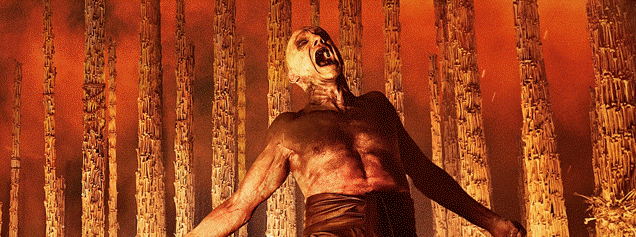
is nicknamed Old Nick (Ralph Fiennes). Kelson, surrounded by vast bone
sculptures that symbolize a dark worship of death, becomes a central figure in
the evolving story.
Kelson’s eccentricity shapes his outlook; he treats carnage as routine due to
constant exposure. This penchant for dark humor surfaces when he casually drags
away a pregnant corpse while singing Duran Duran’s “Girls on Film.” A poster of
lead singer Simon Le Bon in his room further underscores his quirks and suggests
an attachment to early MTV.
Kelson covers himself with red paint and iodine for infection protection, making
him resemble the devil that Jimmy worships. Their leader, Sir Lord Jimmy
Crystal, claims Kelson is the devil’s son. As a result, Kelson makes a pact with
Crystal to play along and reinforce Crystal’s authority and mystique. Meanwhile,
Nick, an atheist and humanist, is the only decent person in the film, so it’s
not surprising when he turns the tables on the despicable leader of the Jimmies.
Adding to its complexity, the film is highly international, drawing parallels
between Robert’s aid to Jimmy and the Allies' assistance to the Axis at the
close of World War II. Numerous references to Brexit also appear—subtle details
likely to elude many American viewers.
The film makes great use of Iron Maiden's “The Nature of the Beast” during a
monumental dance sequence. To convince the cult members that he is evil, he
lip-syncs and performs a sinister dance to the song, fully convincing them of
his wickedness. This stands as one of the best uses of a hard rock song since
the Iron Man film featured AC/DC in an iconic sequence.
Unlike most sequels in long-running horror franchises—many of which exist just
to profit from a successful concept—this entry chooses to tell an ambitious story set in the original film’s universe. While not quite reaching
the heights of the first Romero zombie cycle, it stands above most genre films.
I hope it finds a new audience on streaming.
|