|
 (120725)
One Battle After Another is a taut thriller that blends heartfelt, moving family
drama with topical political themes. It is one of the most critically acclaimed
American films of the year so far, and it is bound to appear on many Top Ten
lists of 2025. It will likely also be an Oscar contender in several major
categories. It has a strong chance to earn Paul Thomas Anderson's first Best
Director Oscar. For the most part, the film deserves all of the overwhelmingly positive
advance hype it has recieved. (120725)
One Battle After Another is a taut thriller that blends heartfelt, moving family
drama with topical political themes. It is one of the most critically acclaimed
American films of the year so far, and it is bound to appear on many Top Ten
lists of 2025. It will likely also be an Oscar contender in several major
categories. It has a strong chance to earn Paul Thomas Anderson's first Best
Director Oscar. For the most part, the film deserves all of the overwhelmingly positive
advance hype it has recieved.
Over the last twenty years or so, director Paul Thomas Anderson has earned a
reputation as one of the most consistently superb filmmakers of his generation.
Like one of his biggest influences, Robert Altman, Anderson is exceptionally
good at juggling multiple storylines and huge ensemble casts. Like Michael
Gondry and Charles Kaufman, Anderson is part of the '90s generation of
filmmakers who cut their teeth making music videos before graduating to feature
films. Anderson made many well-regarded classic music videos collaborating with
artists such as Fiona Apple, Haim (whose lead singer starred in
Licorice Pizza),
and Aimee Mann, who did the haunting theme song for Magnolia. But his most
fruitful collaborations were with Radiohead, its solo members, and the Radiohead
spin off band, the Smile. Thom Yorke, the lead vocalist of Radiohead, composed
much of the effective, atmospheric soundtrack for One Battle Over Another,
creating tracks that are much closer to avant-garde jazz than rock, which go
perfectly with the film. This is undoubtedly one of the most effective
soundtracks of the year, and it deserves a best soundtrack Oscar nom if not a
win in that category.
Almost all of Anderson's films (unlike the similar named Wes Anderson, who
has given us an occasional
clunker) have been near great or masterpieces, including Boogie Nights (97),
Magnolia (99), Punch Drunk Love (2002), There Will Be Blood (2007), The Master
(2012), Phantom Thread (2017) and
Licorice Pizza (2021). So far, One Battle
after Another has been a decent critical and financial success, making it
Anderson's highest-grossing film so far.
The film's cast is led by Leonard DiCaprio, one of the most prominent actors and
celebrities on the planet. He has worked with some of the most acclaimed living
filmmakers, including Quentin Tarantino (Django Unchained and
Once Upon a Time in Hollywood),
Christopher Nolan (Inception) and Martin Scorsese (The Aviator,
Killers of the Flower Moon, and
Wolf of
Wall Street). Usually, the directors do more to
elevate DiCaprio than vice versa. But here DiCaprio gives an excellent
performance that actually rises to the levels of the great director. It is one
of his best roles in one of his best films, although I would rank it below
Inception.
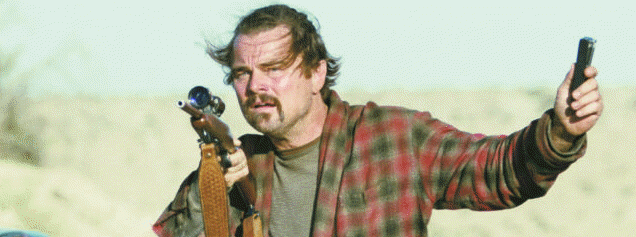
DiCaprio plays Bob Ferguson, a former left-wing terrorist who has since reformed
(or sold out, depending on your point of view) and is living a quiet life as a
loving father to his teenage daughter. In his younger days, he was more ruthless
and even capable of blowing up a building for the right cause. But the years
have softened him, and he has become a loveable if slightly buffoonish dad who
now places his daughter above everything. But the US government is still looking
for him, and if he makes the wrong move, his life will be ruined, and his quiet
middle-class existence will fall like a deck of cards. Among the crimes he is
wanted for is invading an immigrant detention center and freeing the detainees.
It's impossible not to think of ICE during the scene. One of the best and
quietest scenes that best captures his character is when he falls asleep while
getting stoned while watching the classic film The Battle of Algiers, which
sometimes served as a cinematic instruction manual for revolutionaries in the
60s.
The film is an examination of the terrible costs of the countercultural
movements of the sixties. Bob's absent wife, Perfidia (Teyana Taylor), was in
the same terrorist group as him, the French 57, who seem to be at least
partially modeled on the radical left-wing militant group The Weathermen. But what makes Perfidia a great
revolutionary makes her a lousy mom, so she steps aside and lets him raise their
daughter alone. The daughter, Willa (played by the actress with the great name,
Chase Infiniti), has grown into a bright, intelligent, respectful, and
resourceful young woman. Like many teen girls, she loves her dad deeply, even
though she is often embarrassed by him. Her dad must live under the radar and
keep his life secret, so we can't even allow his daughter to have a cell phone.
But of course, since she is a modern young woman, she has a secret phone, but
only a few friends know about it.
Sean Penn's terrific, monumental performance is the film's most impressive
aspect. He gives one of his finest performances, which is saying something since
he was also great in Falcon and the Snowman (1985), At Close Range (1986), Dead
Man Walking (1995), Mystic River (2003), and
Milk (2008). He dominates every
scene he is in entirely. Once again, he shows us in his late-career peak, that he is
one of the most worthy heirs to Marlon Brando and James Dean in method acting.
His character, Lockjaw (no relation to the Inhumans' dog), is pursuing both the
dad and the daughter for various reasons, some known and others unknown.
Lockjaw
is trying to get into a very exclusive right-wing, evangelist, racist military
group called the Christmas Adventurers' Club, which pokes fun at the Bohemian
Club.
The primary purpose of the group is to deflect immigrants and discourage foreign
influences to keep America pure and white. When they meet, they greet each other
with "Hail St Nick," and when they separate, they say, "May Saint Nick be with
you." Part
of the film is definitely a satiric critique of right-wing conservatives and many
right-wing commentators have complained that this part of the film is
stereotyping the religious right, ICE, and MAGA. The film also pokes fun at left-wing cannabis loving feminists when it depicts the fictional group, Sisters of
the Brave Beaver, which mocks the real-life Sisters of the Valley. The film uses
exaggeration effectively to satirize both the extreme factions of the right and
the left. However, we get to know the left better, and they are generally
portrayed more sympathetically.
As we delve deeper into the story, Lockjaw begins to suspect that he is Willa's
actual father. If he were outed as being the father of a partially black child,
this would probably result in both the end of his candidacy for the Christmas
Adventurers Club and perhaps even his life. So, this gives him an added reason
to find and destroy all evidence of Willa. So, this pits Bob the likeable former
revolutionary turned peace-nik antihero, who is often stoned and loves his
daughter above everything, against Lockjaw, the utterly despicable military
psycho who will do anything to save his racist right-wing rep. This all leads to
an unexpected and tremendously satisfying conclusion in which some measure of
justice is delivered.
The main reason I haven't give the film four stars (for now) is that I only saw
it once. Anderson's films (like Kubrick's) are so complicated and
multi-dimensional that you usually can't absorb them all right away, and they
get better every time you see them. The film may age better than some of this
year's films; I rank it higher for now, like
The Shrouds and
Pavements.
But the release of any Paul Anderson film is a major cinematic event and cause
for celebration.
|