|
 (122125)
Since it is awards season, many studios are releasing some of their best and
most prestigious films, timing their releases to maximize their Oscar, Golden
Globe, and Independent Spirit Award potential. In the last few weeks, I have
seen Oscar hopefuls Hamnet, Jim Kelly, and Nouvelle Vague, as well as the less
impressive Wicked Forever and
Frankenstein,
though they each had some strengths. But by far the best film I have seen
recently is Sentimental Value, which is currently showing at selected local
theaters. It has already gotten an impressive eight Golden Globe
nominations, including the major categories: best dramatic film, best director,
and best actor. It is also the frontrunner in many categories at the European
Film Awards and is expected to win in many of the major ones. It was also
selected to represent Norway at this year’s Academy Awards and earned the Grand
Prix Award at the Cannes Film Festival. (122125)
Since it is awards season, many studios are releasing some of their best and
most prestigious films, timing their releases to maximize their Oscar, Golden
Globe, and Independent Spirit Award potential. In the last few weeks, I have
seen Oscar hopefuls Hamnet, Jim Kelly, and Nouvelle Vague, as well as the less
impressive Wicked Forever and
Frankenstein,
though they each had some strengths. But by far the best film I have seen
recently is Sentimental Value, which is currently showing at selected local
theaters. It has already gotten an impressive eight Golden Globe
nominations, including the major categories: best dramatic film, best director,
and best actor. It is also the frontrunner in many categories at the European
Film Awards and is expected to win in many of the major ones. It was also
selected to represent Norway at this year’s Academy Awards and earned the Grand
Prix Award at the Cannes Film Festival.
The film was directed by Joachim Trier, a highly respected Norwegian-Danish
filmmaker who previously directed Reprise (2008) and The Worst Person in the
World (2021). He is known for writing heavy, deep, psychologically complex
character studies and melodramas influenced by Ingmar Bergman. Some critics see
him as a natural successor to such greats as Ingmar Bergman, Victor Sjöström,
Billie August, and Carl Dreyer. There is actually a great shot in Sentimental
Value, in which the face of the main character merges with the faces of his
daughters, which could have come out of
Persona (1967).
Sentimental Value stars Stellan Skarsgard, who was a regular repertory player in
the films of the great, sadly retired Lars Von Trier, who helped found the Dogma
95 movement. They worked together in Breaking the Waves (1996), Dancer in the
Dark (2000), Dogville (2003), and Melancholia (2013). Stellan also distinguished
himself in more high-profile films such as
Avengers: Age of Ultron (2015), Mamma
Mia Here We Go Again (2018), and
Dune (2021).
Rounding out the fine cast is Elle Fanning, who was terrific in this years
Predator: Badlands
and The Great, a Hulu show that is one of their more delightful offerings. Her
performance in last year’s
A Complete
Unknown, in which she is almost
unrecognizable as Dylan’s girlfriend and muse Sylvie Russo, was also marvelous
and unforgettable. Fanning brings a bright, infectious energy to all of her
roles. The film also features Renate Reinsve, who was in Trier’s The Worst
Person in the World, for which she won some major awards, and Inga Ibsdotter,
who won the best supporting actress award for this film from the National Board
of Review. The actors are so high caliber that most directors would kill to work
with them.
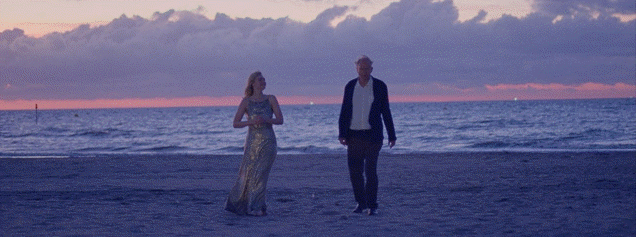
Stellan, who gives a stellar, award-worthy performance, plays a brilliant but
troubled director named Gustav Borg. He has neglected his family for years,
which may be part of the reason that his daughters want nothing to do with him
(George Clooney’s character is in a similar situation to Jim Kelly). His
daughter, Nora, is an excellent actress who suffers from panic attacks. Despite
her acting accomplishments on stage, she never felt like she had obtained her
dad’s approval. She is a great stage actress, but her father always looked down
on theatre and treated her stage performances as trivial; Borg even walked out
on her highly acclaimed portrayal in an Ibsen play. Despite his advanced years,
he refers to Nora’s work as “old plays for old people.” He seems borderline
delusional, as if he’s part of the modern world that has rejected him, and he
talks to a much younger waitress as if they are having an affair.
His other daughter, Agnes (Inga Ibsdotter), was in one of her productions, but
since then, they have drifted apart. Now she has nothing to do with acting and
lives a quiet, trauma-free life with her son. She does not want her son to be
doted on and casually pushed aside the way she was.
Gustav had divorced his psychotherapist wife, and it is hinted that he had
numerous affairs with the actresses he worked with. After his divorce, he had
far less interaction with his family, and he had long since moved out of the
family home.
Recently, the director’s estranged wife died. In one of the most painful scenes,
the daughters go through her belongings and reconnect with old memories, which
is probably something anyone who has lost their parents can relate to.
Then he writes a great script that deals with his Holocaust survivor mom, who
could not deal with her memories of being tortured by the Nazis, so she
committed suicide. He specifically wrote the role for his daughter, and he wrote
the script in a very desperate attempt to reconnect with his daughter. He tries
to convince her to play the role of her grandmother. And in a seemingly sadistic
twist, he wants to film it in the family home, in which he recently moved back,
in which his mom hung herself, and he wants to stage the scene in the exact spot
where it happened.
After his daughter rejects the role even though she thought the script was
great, he reluctantly gives it to a popular American actress, Rachel Kemp (Elle
Fanning). Kemp is a big star, but she hopes working with Borg will elevate her
artistic credibility, and he, in turn, hopes working with her will improve his
commercial potential. Just casting her in the film will help him secure an
exclusive Netflix deal, but he mistakenly thinks this will also guarantee that
the movie will be shown in theaters. But the two people who come from different
worlds are also genuinely fascinated with each other, and audience members might
detect some possible romantic sparks and chemistry between them, or maybe Gustav
thinks of her as a daughter figure who gives him the affection his daughters
deny him.
The film also explores aging in the film industry. Gustav is seen by some of his
peers as old school and washed up. As a goodwill gesture, he wants to include an
old friend and former collaborator, an accomplished cinematographer, to shoot
the film. But when he visits him in person, he is shocked to see that the man is
half dead, and he has to find someone else, presumably a younger man. The scene
hints that the writing on the wall also applies to him, and his career days may
be numbered.
Either Gustav has a morbid sense of humor, or he is one of the world's worst and
most clueless grandparents. He seems to have no idea of what constitutes
appropriate behavior around children. He gives his grandchild a shockingly
inappropriate gift, a DVD of The Piano Teacher about an SM affair between a
student and a much older teacher, as well as the told in reverse rape revenge
film, Irreversible (Both are great films that no one under 21 should see). He
also wants to use his grandchild in a small role in his new movie, but his mom
is afraid this might damage him.
Spoiler alert: Both this film and Hamnet (which I will review soon and also
flirts with greatness) have much in common. Both films feature male artists who
seem more connected to their art than to their family. And both films end with a
cathartic scene that demonstrates the healing power of art. Here, the scene
takes place in a movie, and in Hamnet, it is in a play.
Both
One Battle After Another
and Hamnet are getting most
of the current Oscar buzz, perhaps partially because they are entirely in English, and
One Battle After Another also relates to current events such as protests,
authoritarianism, and immigration, which could help it win. But Sentimental
Value, which is also doing well in the Oscar nomination race, is a superb film, and it
often has acting, direction, and cinematography that are equal to or superior to
those of those films. It is by far the wisest and most emotionally intelligent family
drama of the year, and it is one of the best films of 2025 in general. This
mature film makes most of the year’s other films look like kids’ stuff in
comparison, and it harkens back to an era when more filmmakers aspired to create
high art rather than maximize profit.
|