|
 (121425)
Despite its excellent reviews, Guillermo del Toro's long-awaited Frankenstein
film on Netflix is a bit of a disappointment. The basic story from the classic novel
is, of
course, how an arrogant young doctor breaks God’s laws by creating a new
being out of body parts taken from corpses. Eventually, the monster rebels,
which inspired comparisons of both the doctor and the monster to Satan in John
Milton's also classic story
Paradise Lost. The theological implications, which I have always found to
be among the
novel's best aspects, are downplayed in this new film version-but they remain
present. This is evident when the words “Only a Monster would play God” flash on
the screen. (121425)
Despite its excellent reviews, Guillermo del Toro's long-awaited Frankenstein
film on Netflix is a bit of a disappointment. The basic story from the classic novel
is, of
course, how an arrogant young doctor breaks God’s laws by creating a new
being out of body parts taken from corpses. Eventually, the monster rebels,
which inspired comparisons of both the doctor and the monster to Satan in John
Milton's also classic story
Paradise Lost. The theological implications, which I have always found to
be among the
novel's best aspects, are downplayed in this new film version-but they remain
present. This is evident when the words “Only a Monster would play God” flash on
the screen.
The film is an adaptation of the 1818 Gothic novel by the then 17-year-old Mary
Shelley, but its setting here has been moved seventy plus years forward into the Victorian era for unknown
reasons. The story has been remade dozens of times in various media making the "monster" character
only slightly less popular than Sherlock Holmes or Dracula.
The two best Frankenstein films are the Universal Karloff/Whale films, which split parts
of the novel into Frankenstein (1931) and Bride of Frankenstein (1935). The
third film in the series, Son of Frankenstein (1939), is also very good, but it
draws little from the novel.
I also loved the filmed play version from National Theatre Live, in which
Benedict Cumberbatch performed two versions of Frankenstein, switching between
Dr. Frankenstein and the monster. Before this Netflix adaptation the monster was
last seen in James Gunn's Creature Commandoes animated series for HBO and in a
clever twist,
the monster appears as an immortal stalker of his immortal bride.
This new film is neither the most nor the least faithful translation of the
story. Like most adaptations, the film only takes from the novel the parts the
filmmakers think will work visually. Most of the changes this version makes from
the novel do not improve the story or add depth. This version feels like it is a patchwork quilt of parts of the novel, plays,
and other film versions, and often the parts do not go together well. For instance,
there is a scene early on that seems misplaced in which the monster demands that
the sailor hand over the doctor, and he throws around over a dozen of them as if
they were rag dolls, and it's sheer overkill. The action in the scene feels more like
it belongs in an X-Men or Hulk film than in a Frankenstein flick. I think it was
a mistake to give the monster both immense super strength and a healing factor
that rivals Wolverine’s. He always has more strength than a human, but not this
much. In the original novel, he was just a tall, walking corpse with superior
athletic abilities, but stronger only because he was tall.
Directed by Guillermo Del Toro, known for visually effective, arty
horror and fantasy films. Some of his other features include Crimson Peak
(2015), Hellboy and
Hellboy II: The Golden Army (2008),
Pan's Labyrinth
(2006),
Pacific Rim
(2013), and
The Shape of Water (2018), which won him a Best Picture Oscar despite not even being his best film.
The film’s good cast also includes Oscar Issac (Moon Knight
(2022) and an upcoming
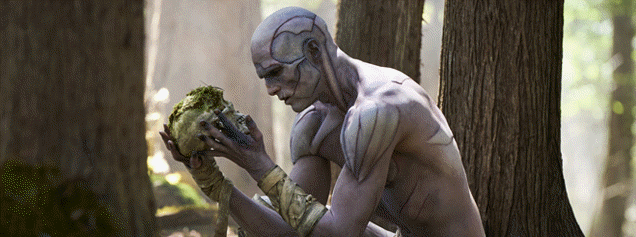
Batman film). Jacob Elordi is the more-than-usual sympathetic monster (called
the creature in the novel). Christopher Waltz from
Django Unchained (2013), who plays
Dr. Frankenstein’s mentor, as well as Mia Goth, who plays his intended bride,
Elizabeth. Most of these performances are competent to good, but none of them
make a lasting impression.
A big draw for many viewers will be the supporting performance by Mia Goth, who
got her big screen debut in Lars Von Trier’s controversial Nymphomaniac. She is
the current reigning horror queen and has a resume almost as impressive as Del
Toro's. Some of the recent cinematic triumphs include
X (2022),
Infinity Pool
(2023),
Maxxxine (2024), and
Pearl
(2022), and she is rumored to play Lilith, Dracula's daughter, in upcoming MCU films. This is the only film I have seen her in
in which she was not outstanding, but she looks great in the period clothing.
The start of the movie, like the end of the novel, takes place in the coldest
part of the world, the Arctic Circle. A bunch of sailors encounter both the
gravely ill Dr.Frankenstein and the creature that destroyed his life. In the
next two sections, which are broken into chapters like the novel, each tells its
side of the story.
Dr. Frankenstein’s side of the story starts out with the doctor recapping
his childhood. His mother, the only person who shows the boy any compassion,
dies early, and the boy has obviously been damaged by his mom’s loss, and does
not seem to be able to relate to or interact with women well. Freud fans would
have a field day with the fact that actress Mia Goth plays both Victor
Frankenstein’s mom and his main love interest, who is romantically linked to his
brother. In the novel, it’s even worse because she is Victor’s sort of sister
and cousin, and fiancée. His father, who is played by Charles Dance, is a master
surgeon. He is overly demanding and psychologically abuses his son Victor. In
one of the film’s successful changes from the novel, the film suggests that
Victor’s bad parenting of the monster was the model for how Victor mistreated
the monster. As a child, Victor is visited in his dreams by a dark angel who
encourages him to pursue his lifelong dream of creating life. This can be read
as a demonic presence or just a manifestation of Victor’s dark side.
The doctor gives life to his assemblage of corpses without considering the
possible negative consequences. Like many of the films and unlike the novel, the
doctor animates him by harnessing electricity with an impressive-looking gizmo
and feeding it to him. At first, the doctor is a relatively good and patient
parent. But when the monster’s speech stalls and the monster can’t say anything
more than Victor, the doctor grows impatient and chains him up to a pillar. Like
his dad, who was impossibly demanding Victor can’t stand the fact that his son
is not as brilliant as he would like. Their relationship is like that of an
abusive parent to a mentally challenged child.
Although Elizabeth and Victor’s brother are engaged, Victor has an attraction to
her, and there is some flirtation between the two. Both Elizabeth and her
fiancé, who in this version is Victor’s brother, are aware of the monster. She
strongly disapproves of the doctor’s mistreatment of the creature. She takes
pity on the monster and, for a brief moment, there seems to be some potential
romantic tension between her and the monster, who is less ugly than usual in
this version. She is religious, and unlike the doctor, she believes the creature
is more innocent than typical humans because he is not blemished by original
sin.
The portrayal of Elizabeth is one of the film's least impressive aspects, and
part of the problem is that she is written as a contemporary Christian woman
with modern sensibilities, dropped into the Victorian era. In the novel, she was
Victor’s devoted and loving fiancée/cousin, but she has little romantic
chemistry with the actor who plays Victor here. I also found it a bizarre
creative choice that there almost seems to be a budding romantic interest
between her and the monster (this is never followed up on), and that there is
more romantic chemistry between her and the monster and between her and Victor.
Del Toro’s Frankenstein does have great set design, alluring shot composition,
and all-around beautiful visuals. It is certainly nowhere near the quality of
the Frankenstein spin-off
Poor Things
(2024), which does a better job of modernizing and
exploring the novel's ideas. But not one moment of the film is actually
chilling, scary, or frightening. And isn’t that the main point of making a
horror film?
|