|
 (082626)
Blue Heron follows the train of thought of a young woman’s mind, exploring her
lifelong memories of her troubled brother. The memories are often depicted as
intentionally amateurish-looking shots of hazy dreams and crude camcorder clips
that sometimes give the film the look of TV newsreel footage. This intimate
family memory drama is full of devastating revelations, so it is reminiscent of
last year’s
Sentimental Value
plus the court drama
Anatomy
of a Fall
and many
Ingmar Bergman films. It also seems aimed at the same audience as those films. (082626)
Blue Heron follows the train of thought of a young woman’s mind, exploring her
lifelong memories of her troubled brother. The memories are often depicted as
intentionally amateurish-looking shots of hazy dreams and crude camcorder clips
that sometimes give the film the look of TV newsreel footage. This intimate
family memory drama is full of devastating revelations, so it is reminiscent of
last year’s
Sentimental Value
plus the court drama
Anatomy
of a Fall
and many
Ingmar Bergman films. It also seems aimed at the same audience as those films.
This is the first full-length film by the Canadian Hungarian filmmaker Sophy
Romvari. Her film defies easy categorization and sits somewhere between a
documentary and a docudrama. 2026 has seen the debut films by new and
significant filmmakers such as Adrian Chiarella’s Leviticus, Cury Barker’s
Obsession, John Early’s Maddie’s Secret, and Kane Parsons’ Backrooms. But Blue
Heron is by far the most dramatically sophisticated and emotionally resonant
film by a new director that I have seen this year. Critics widely consider it
one of the best films of the year.
The film features several avatars, or stand-ins, for the writer/director that
reveal the main character's memories. Still, the film's two parts with different
narrators do not always mesh smoothly. Also, some parts of the film are
contradictory, so it makes you question the accuracy of memory. The film opens
with the words, “ It’s true I spent much of my time angry at him, but the older
I get, the less it feels like I knew him at all.” This starts us questioning our
memories and what we think of as reality right away.
The film begins by introducing us to a Hungarian family that has recently moved
to Vancouver Island in Canada. The family is comprised of Jeremy (Edik Reddoes),
the unruly teenage brother of Sasha (Eylul Guyen), Henry (Liam Serg), and Felix
(Preston Drabble). The family has much in common with the real-life family of
the director, Sophy Romvari, and is obviously based on her family.
The family is obviously very dysfunctional. The dad, played by Adam Tompa,
spends almost all his time between his dark room and his computer. This leaves
his overtaxed wife (Trngo Reti) to babysit her children when they are home from
school, and they have serious problems she must constantly deal with.
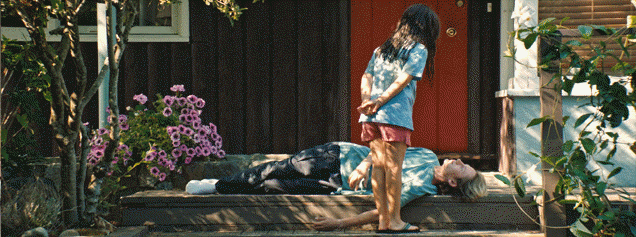
Jeremy is especially anti-social, has trouble communicating, and habitually gets
into trouble. He is often caught stealing, and he has angry rages or is silent
for long periods of time. He also punches through a window in the middle of the
night and is caught jumping up and down on the roof. In older times, he would
have been seen as possessed and perhaps would have been put in a jail or
institution. He continually disrupts the peace and de-centers the family.
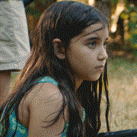
Sasha, a teen girl standing in for the director, is seen by everyone as more
“normal”. She can meet new friends easily. But her mom forbids her from ever
inviting them over because she seems sure that Jeremy will act out in front of
them and embarrass the family.
Jeremy constantly craves attention, and he often tries to get it in negative
ways. At one point, his more stable sister Sasha has carefully assembled a
collection of seashells on the beach, and he threatens to step on them. But then
he acts like he was joking. I don't think he was, but he probably had one of his
frequent mood swings. But then his whole attitude and demeanor change, and he
offers his sister a blue heron key chain as a peace offering, which, as it turns
out, was the product of one of his shoplifting expeditions. Even when he tries
to do good, he does it in a bad way.
The film's second half becomes even more intriguing as it shifts as dramatically
and quickly, without warning, as Jeremy’s emotions. We begin to hear narration
and see things from adult Sasha's perspective (previously she was still a girl).
She has now become a filmmaker like the director Sophy Romvari and begins to
show and describe shorter film shots and sequences made into film based on her
real-life memory fragments. Some shots are presented close to how they must have
happened, but other times they are based on scenes the main character wasn't
even there for. Some of these unorganized fragments are among the best sequences
I’ve seen all year, and they reflect the chaotic nonlinear nature of real
memory.
The psychologist doesn't give a helpful prognosis, but the boy keeps getting
worse. At some point, the narrator and the audience realize the story cannot
keep going this way: either the dysfunctional boy will destroy the family, or
they will destroy or discard him.
This film is not showing at theatres anymore, but it is surely worth hunting
down on streaming. It is surely the most emotionally devastating film I have
recently seen, and it is probably one of the best art house films I have seen
all year. Although I would not call the film accessible, it has superior
character development and haunting images compared to most of the year’s films.
|