|
 (030826)
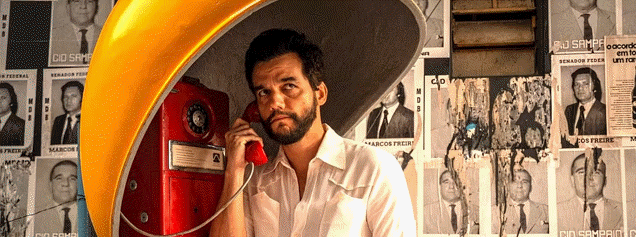
The Secret Agent is an absorbing and unusual crime thriller, portions of which
are unusually dark and somber with instances of surreal and absurd humor
sprinkled throughout. It all takes place in 1977 during a military dictatorship
in which free speech was strictly restricted. If anyone would say a wrong word
to a police officer or criticize a politician, they could get carted away and at
times spend years in jail. The film is reminiscent of a Luis Buñuel film because
at times it has several fantastic and grotesque images that don’t quite seem
real. At times it seems like the film is being weird for its own sake, but for
me that also became part of its charm. (030826)
The Secret Agent is an absorbing and unusual crime thriller, portions of which
are unusually dark and somber with instances of surreal and absurd humor
sprinkled throughout. It all takes place in 1977 during a military dictatorship
in which free speech was strictly restricted. If anyone would say a wrong word
to a police officer or criticize a politician, they could get carted away and at
times spend years in jail. The film is reminiscent of a Luis Buñuel film because
at times it has several fantastic and grotesque images that don’t quite seem
real. At times it seems like the film is being weird for its own sake, but for
me that also became part of its charm.
Although it just recently received a wide release in Chicago, this is actually
one of the most honored and critically praised films of last year. The film won
the Best Actor award at the Cannes Film Festival. It also took home Best
Non-English Film and Best Actor in a Motion Picture at the Golden Globes, and
the actor Wagner Maura is the first Brazilian actor to get this honor. In
addition, it was nominated for Best Picture, Actor, International Film, and
Casting at this years Academy Awards. The Secret Agent is only the second
Brazilian film to be nominated for Best Picture. Although it is more than worthy
of being nominated, I will be rooting for
Sentimental Value for Best Film and Timothe Chalamet or Leonard Di Caprio for Best Actor. The film’s popularity with
Oscar voters reflects the academy’s increased international nature after the
release of
Parasite. Several other foreign films, like
Sentimental Value and It
was Just an Accident, also received nominations in many major Oscar categories
this year.
The Secret Agent is divided into three parts, or chapters, and each has a title
that relates to its content. The first part, “The Nightmare” which explores the
main character Marcelo’s bittersweet homecoming to the Brazilian city of Recife
after the death of his wife. His return home also leads to his reunion with the
son he had not seen in a long time. Early in this part the main character
Marcello stops at a gas station to refuel his car. He sees a body on the floor,
and a worker explains that a man tried to steal gas, so he shot him. No one
there thinks to dispose of the body and even the police ignore it even after
insects have begun to devour the body. The image is reminiscent of a classic
scene in Bunuel’s “Un Chien Andalou“, in which ants come out of a hand. This
scene also shows the casual attitude the population has towards the deaf, a
handicap that even the police seem to ignore.
The film has an odd obsession with sharks. The theatre where Marcelo’s best
friends works has been showing Jaws, which helps set the film in 1977, and we
keep seeing images of the memorable movie poster. Marcelo’s son keeps seeing the
ads and demands that his dad take him to see it, even though he has nightmares
about sharks every night. Meanwhile, the Chief of Police is doing an
investigation which involves the remains of a tiger shark with a huge human leg inside
it. The film keeps going back to that grotesque image which seems to serve as a
symbol for the cold-blooded predatory politicians that run the country.
In the second part of the film. “Identification Institute,” the main character
has established a normal life and friends, when two mysterious men close in on
finding Marcelo for unknown reasons. At one point, he meets a mysterious woman
in a one-time rendezvous who has demanded to meet with him. She tells him that
he has been targeted by two assassins. The hit was placed on him because he
crossed some of the most powerful industrialists. He makes deals to get false
passports in case he needs to quickly leave the country. People keep
disappearing and dissidents are constantly killed probably for political
reasons. The local police officers are completely corrupt, and they are working
with local criminals. Politicians, police, and criminals are all coconspirators.
They want to keep a bunch of murders secret, so they go on a bridge and
nonchalantly dump a bunch of bodies into the river. It’s shocking that they have
such a nonchalant attitude towards death and murder.
The film’s third part, “Blood Transfusion," finds Marcello hiding in his
hometown of Recife, interacting with his new friends. He sometimes has trouble juggling
the many different identities that he has taken on to elude the pursuers he has
taken on from Parts One and Two.
The Secret Agent tries to capture an atmosphere in which slow paced calm scenes
can suddenly explode with random violence or shocking sexual acts. In one scene
police officers are gunned down by other police officers and their faces are
shown indistinct with features covered in red. In another the camera pans around
a park in which almost everyone is having every type of imaginable sex both
heterosexual and homosexual. The film is very complex and as packed with as many
characters as
One Battle After Another, making it hard to digest. I also think
that some characters and scenes could have been cut without jeopardizing the
story and at 140 minutes the film feels a little too long. But the film is
packed with many lively performances (the lead Moura and Tania Maria are
particularly good), and it perfectly captures the beauty, ugliness, sensuality
and random violence of Brazil.
It’s a messy, undisciplined film that has more than its share of fine moments.
Despite its flaws, the film earns more than its pretensions, and it should be
considered mandatory viewing for cinephiles who are not averse to subtitles.
|