|
 (111209)
It’s a tale told joyfully and told often, gobbling up film, stage, and audio
adaptations with incredible regularity. Charles Dickens’s 1843 novella, “A
Christmas Carol,” has been reworked and reheated time and again (the best
adaptation remains the 1951 version starring Alistair Sim), and who could blame
anyone for trying? Perhaps the perfect tale of rekindled morality set against
the backdrop of the most enchanting of holiday seasons, “Carol” is brought back
to life for another cinematic go-around, this time through the eyes of
writer/director Robert Zemeckis and his motion-capture (mo-cap) animation tools.
While shadowing Dickens’s work as much as possible, the latest “Carol” takes a
technological leap forward, offering a newly abstract take on a perennial saga
of remorse. (111209)
It’s a tale told joyfully and told often, gobbling up film, stage, and audio
adaptations with incredible regularity. Charles Dickens’s 1843 novella, “A
Christmas Carol,” has been reworked and reheated time and again (the best
adaptation remains the 1951 version starring Alistair Sim), and who could blame
anyone for trying? Perhaps the perfect tale of rekindled morality set against
the backdrop of the most enchanting of holiday seasons, “Carol” is brought back
to life for another cinematic go-around, this time through the eyes of
writer/director Robert Zemeckis and his motion-capture (mo-cap) animation tools.
While shadowing Dickens’s work as much as possible, the latest “Carol” takes a
technological leap forward, offering a newly abstract take on a perennial saga
of remorse.
A shriveled, angular miser, Ebenezer Scrooge (voiced by Jim Carrey), has allowed
his heart to harden over the years, shutting out the affections of his nephew,
Fred (Colin Firth), and making life difficult for his sole employee, Bob
Cratchit (Gary Oldman). To help mend his miserable ways, the spirit of old
business partner Jacob Marley (Oldman) warns Scrooge that he will be visited by
three ghosts: Christmas Past (Carrey), Christmas Present (Carrey), and Christmas
Yet to Come. Sweeping Scrooge up into the sky, the spirits show the vile man the
error of his ways, detailing a life of misery if he continues down a path of
bitterness.
Zemeckis first toyed with mo-cap on 2004’s holiday extravaganza, “The Polar
Express.” It was an experimental triumph, showing off the dynamic range of the
animation and the performances, which allowed free range to make it all come to
sparkling life. 2007’s “Beowulf” divided audiences, but nevertheless proved
again that mo-cap permitted Zemeckis to seek out new avenues of artistic
release, indulging grand visions of camera fluidity and thespian dexterity.
Certainly, his live-action work is missed, and even though Zemeckis has found
some inspiration with mo-cap, that’s interesting to see; an occasional return to
the land of the living would suit him well.
“A Christmas Carol” submits a unique challenge for Zemeckis and the mo-cap
aesthetic. It’s a legendary story, immortalized in a thousand different forms.
The repetition urges the filmmaker to challenge the staleness of the tale,
working the tech buttons and levers to reimagine a Dickensian world with
stunning 360-degree detail (enhanced naturally if one chooses a 3-D theatrical
experience), live-action can’t quite accomplish this on a sensible budget. It
goes beyond chipped cobblestones and apple cheeks to the otherworldly tangents
of the source material, depicting three ghosts with mysterious, unsettling
powers of persuasion that have the sort of silver screen dynamism Zemeckis loves
to fiddle with.
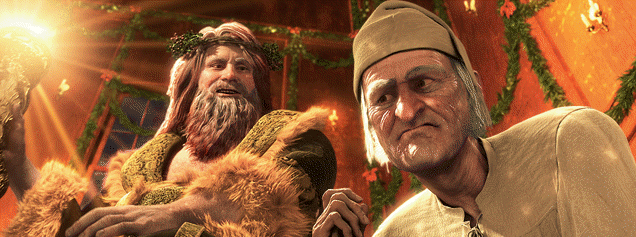
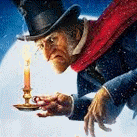
The animation in “Carol” is quite good, reworking known elements into graphic,
riveting extremes. Scrooge isn’t simply a man of meager soul, but a
near-reptilian creature folding at the waist, excited only by money and cruelty.
The CG work enjoys the challenge of representation, merging the actors' features
with the exaggeration of the characters. While Scrooge is nicely crusted and
skeletal (losing Carrey’s distinct Carreyisms in the process), the rest of the
roles find a happy medium between literary homage and modern star power, with
little recognizable patches of Oldman and Firth (along with Robin Wright Penn
and Bob Hoskins in various supporting roles) fed into the plump, Victorian
spirit.
Behind the animated flamboyance are performances that tunnel deep into the
material's dramatic possibilities. It should be noted that this “Carol” is
perhaps the least emotionally gluey version in quite some time, with Zemeckis
utilizing significant passages of silence and discombobulating psychedelics to
articulate Scrooge’s illuminating interaction with the three ghosts. The film is
cold to the touch, but not easily written off. Jim Carrey’s lead performance
contains heady passages of pathos within a fine piece of acting that not only
burrows into Scrooge’s panic but also his disorientation in the presence of the
phantoms, who offer the miserable man passage to a bleak future. It’s a vocal
fantasia for Carrey, creatively working through the multiple roles, with only
animation flourishes giving him away.
While sticking close to Dickens, Zemeckis runs off to play with a few moments of
ill-conceived action. The worst features Scrooge shrunk down to the size of a
pencil by the Ghost of Christmas Yet to Come, scurrying through sewers and
nervously riding bottles as he avoids future wrath. Yielding to this sort of
tomfoolery is somewhat understandable, considering the stillness of the film and
the stark depiction of doomsday decision-making. Yet watching Ebenezer fall from
impossible heights and careening through sewers gives the viewer the impression
that they are on board A Christmas Carol: The Ride rather than watching a
narrative. It is the one scene that reeks of audience pandering and nearly sinks
what has come before.
“Carol” isn’t a warm, comforting hug of a feature film. Its sympathies are
projected subtly, assembling a moody picture of technical achievement, not a
glazed retelling of holiday reform. The distance is unavoidable, but I hope that
audiences take the opportunity to drink in the film's craftsmanship and welcome
its unsettling atmosphere. Robert Zemeckis may not have you reaching for the
handkerchief by the end of the picture. Still, he does illustrate what can be
accomplished in an interesting way by merging the elements of cinema past with
those of cinema yet to come.
|